


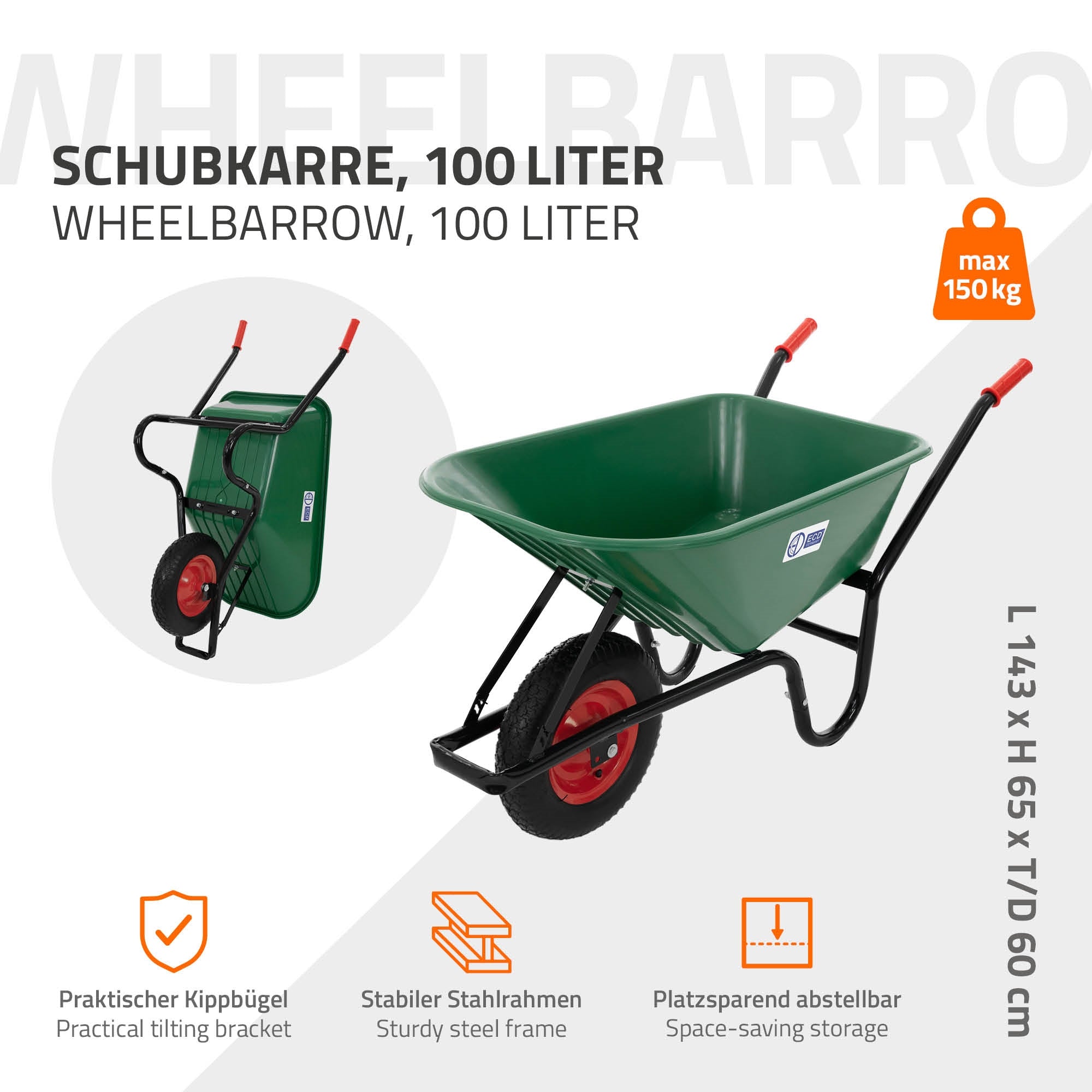
Wheelbarrows – the practical helper for garden, construction, and transport
Whether digging in the garden, transporting soil and compost, or moving sand, gravel, and construction debris on the construction site – a robust wheelbarrow significantly eases many tasks. What appears to be a simple transport device at first glance varies significantly in terms of load capacity, volume, material, tires, and handling depending on the model.
The right wheelbarrow should therefore not only be able to carry as much as possible. It is crucial that it fits the intended use and can be moved safely and controlled even when heavily loaded.
When selecting, load capacity and weight, volume, tub material, tires, frame, handles, and overall workmanship play an important role. Whether for the private garden, renovation work, or professional construction site use – with the right model, heavy loads can be transported much more easily.
What types of wheelbarrows are there?
Wheelbarrows differ mainly in their construction and intended use. While lightweight garden models should be easy to move, construction wheelbarrows place more emphasis on load-bearing capacity and stability.
Garden wheelbarrow – light and versatile
For typical tasks in the garden, a lighter wheelbarrow is often sufficient. It is suitable for transporting soil, leaves, plants, branches, compost, or gardening tools. Models with a capacity of about 80 to 120 liters are particularly practical. They provide enough space for most gardening tasks without becoming unnecessarily heavy and unwieldy.
- easy to push
- sufficiently maneuverable
- robust tub
- comfortable handles
- suitable for uneven surfaces
Construction wheelbarrow – robust for heavy loads
On construction sites, the requirements are significantly higher. Here, sand, gravel, mortar, stones, soil, or construction debris are often transported. A stable construction and high load capacity are therefore particularly important. Robust construction wheelbarrows often have reinforced steel tubs and stable frames. Depending on the model, they can carry over 150 kg and are thus suitable for heavy materials.
Which wheelbarrow is the best?
There is no general recommendation for the best wheelbarrow – what needs to be transported is crucial. For gardening tasks, a lightweight model with a plastic tub can be particularly pleasant, while a heavy steel wheelbarrow shows its advantages on a construction site. Therefore, it is worth taking a look at the ratio of load capacity, volume, weight, and maneuverability when making a purchasing decision.
- stable and durable construction
- controllable movement even when fully loaded
- secure stand
- high-quality handles
- suitable for the intended surface
How much kg can a wheelbarrow carry?
The load capacity strongly depends on the construction, tub, frame, and wheel suspension. Lightweight garden wheelbarrows are often designed for about 80 to 120 kg, while robust models for construction and transport work can carry 150 to 250 kg or more. It is important to pay attention to the maximum load capacity of the respective model.
The heavier the load, the more the surface, center of gravity, and weight distribution affect handling. Therefore, for everyday use, having sufficient load capacity with some reserve is usually more sensible than constantly pushing the maximum weight.
Which wheelbarrow for gardening?
For gardening tasks, the focus is less on maximum load capacity and more on lightweight and comfortable handling. Soil, mulch, leaves, or plants often need to be transported over lawns, gravel paths, or uneven surfaces. A good garden wheelbarrow should therefore be as light as possible while still having a stable tub. A capacity of about 80 to 120 liters is suitable for many typical gardening tasks.
- low weight
- stable plastic or steel container
- air-filled wheel
- ergonomic handles
- good maneuverability
Which wheelbarrow for construction debris and heavy loads?
For construction debris, gravel, sand, stones, or larger amounts of soil, a particularly robust wheelbarrow is recommended. Here, load capacity, tub stability, and a durable frame are especially important. A steel tub is particularly resistant to heavy and angular materials. A stable wheel with a load-bearing axle is also important.
- stable steel tub
- reinforced frame
- high load capacity
- large capacity
- robust wheel
- durable handles
What is better: a wheelbarrow with one or two wheels?
The classic single-wheeled wheelbarrow is particularly easy to turn and is excellent for narrow garden paths or uneven surfaces. A two-wheeled wheelbarrow, on the other hand, is significantly more stable and is easier to control, especially with heavy loads. However, it is less maneuverable and requires a bit more space to maneuver.
- One wheel: high maneuverability and ideal for gardening tasks
- One wheel: good for narrow and uneven paths
- Two wheels: particularly high stability
- Two wheels: ideal for heavy loads
Plastic or metal – which material is better?
The material of the tub also significantly affects the properties of a wheelbarrow. Plastic wheelbarrows are usually lighter and easy to maintain, while steel is particularly stable and load-bearing. For gardening tasks, plastic may be sufficient, but for heavy or angular materials, a steel tub often offers advantages.
Plastic tub
Plastic wheelbarrows are usually light and pleasant to handle. They are excellent for gardening tasks and are resistant to moisture and many weather influences.
- low weight
- rust-free
- easy to maintain
- pleasant to transport
- suitable for gardening tasks
Steel tub
Steel is particularly stable and load-bearing. Therefore, this material is often used in construction and professional wheelbarrows. A coated or galvanized steel tray offers additional protection against corrosion.
- very robust
- high load capacity
- resilient
- ideal for heavy materials
How many liters should a wheelbarrow have?
The right capacity depends on the area of use. For smaller gardening tasks, 60 to 100 liters are often sufficient. Models with about 80 to 120 liters are particularly versatile. For extensive work or construction sites, 120 to 200 liters can be sensible.
- 60–80 liters: small gardening tasks and light transport
- 80–120 liters: versatile all-rounder for garden and home
- 120–160 liters: larger gardening and construction tasks
- from 160 liters: large quantities and heavy transport tasks
The right tires for every surface
The wheel largely determines how easily a wheelbarrow can be moved. Pneumatic tires absorb unevenness well and are particularly suitable for grass, soil, or gravel. Solid rubber tires, on the other hand, are puncture-proof and do not require air, making them particularly suitable for construction sites.
- Pneumatic tires: high driving comfort and good suspension
- Pneumatic tires: particularly suitable for uneven surfaces
- Solid rubber tires: absolute puncture safety
- Solid rubber tires: low maintenance and high robustness
Ergonomics and handling – this is what matters when pushing
A wheelbarrow only becomes truly practical when it can also be controlled well when fully loaded. In addition to weight, handles, center of gravity, and frame construction play an important role. Ergonomically shaped handles make lifting and pushing easier, while a low center of gravity improves control over the load.
Care and maintenance of a wheelbarrow
With some care, a wheelbarrow remains ready for use for many years. After work, soil, concrete residues, and other materials should be removed as much as possible. Especially with steel trays, regular cleaning prevents moisture and aggressive residues from causing corrosion in the long term. The wheel and axle should also be checked regularly.
- Clean the tray after use
- Keep steel surfaces dry
- Check the wheel for damage
- Check air pressure regularly
- Check axle and moving parts
- Treat rust spots early
Price-performance – which wheelbarrow is worth it?
Depending on the area of use and equipment, prices vary significantly. For occasional gardening tasks, inexpensive models are often sufficient, while regular or particularly heavy use justifies a higher-quality wheelbarrow.
Entry-level – approx. 40 to 70 €
These models are suitable for occasional gardening tasks and smaller transport jobs. Typical features include lightweight plastic or simple steel trays, smaller capacities, basic tires, and low weight.
Mid-range – approx. 70 to 150 €
The mid-range is a good choice for regular gardening tasks, renovations, and more demanding DIY projects. Here you usually get more stable frames, higher-quality trays, better wheels, higher load capacity, and a longer lifespan.
Premium and professional class – from approx. 150 €
For frequent and heavy use on construction sites or in commercial areas, premium and professional models offer particularly stable constructions, high load capacity, and durable components.
Why wheelbarrows from ECD Germany?
At ECD Germany, you will find practical wheelbarrows for various applications around the garden, home, workshop, and construction site. Robust materials, reliable construction, and as comfortable handling as possible are the focus.
- stable and durable constructions
- various capacities
- load-bearing trays
- practical tires
- comfortable handling
- attractive prices for DIY enthusiasts and gardeners
Conclusion: The right wheelbarrow for garden and construction site
The right wheelbarrow should always match the intended use. For gardening tasks, lightweight, maneuverable models with about 80 to 120 liters are particularly practical. Those transporting construction debris, gravel, or heavy materials should pay attention to a robust steel tub, high load capacity, and durable tires.
The number of wheels also makes a difference: one wheel offers maximum maneuverability, while two wheels provide more stability with heavy loads. By also considering material, capacity, ergonomics, and tires, one can quickly find a model that noticeably eases daily work.
With a suitable wheelbarrow from ECD Germany, soil, garden waste, building materials, and many other loads can be transported reliably and comfortably.




Wheelbarrows – the practical helper for garden, construction, and transport
Whether digging in the garden, transporting soil and compost, or moving sand, gravel, and construction debris on the construction site – a robust wheelbarrow significantly eases many tasks. What appears to be a simple transport device at first glance varies significantly in terms of load capacity, volume, material, tires, and handling depending on the model.
The right wheelbarrow should therefore not only be able to carry as much as possible. It is crucial that it fits the intended use and can be moved safely and controlled even when heavily loaded.
When selecting, load capacity and weight, volume, tub material, tires, frame, handles, and overall workmanship play an important role. Whether for the private garden, renovation work, or professional construction site use – with the right model, heavy loads can be transported much more easily.
What types of wheelbarrows are there?
Wheelbarrows differ mainly in their construction and intended use. While lightweight garden models should be easy to move, construction wheelbarrows place more emphasis on load-bearing capacity and stability.
Garden wheelbarrow – light and versatile
For typical tasks in the garden, a lighter wheelbarrow is often sufficient. It is suitable for transporting soil, leaves, plants, branches, compost, or gardening tools. Models with a capacity of about 80 to 120 liters are particularly practical. They provide enough space for most gardening tasks without becoming unnecessarily heavy and unwieldy.
- easy to push
- sufficiently maneuverable
- robust tub
- comfortable handles
- suitable for uneven surfaces
Construction wheelbarrow – robust for heavy loads
On construction sites, the requirements are significantly higher. Here, sand, gravel, mortar, stones, soil, or construction debris are often transported. A stable construction and high load capacity are therefore particularly important. Robust construction wheelbarrows often have reinforced steel tubs and stable frames. Depending on the model, they can carry over 150 kg and are thus suitable for heavy materials.
Which wheelbarrow is the best?
There is no general recommendation for the best wheelbarrow – what needs to be transported is crucial. For gardening tasks, a lightweight model with a plastic tub can be particularly pleasant, while a heavy steel wheelbarrow shows its advantages on a construction site. Therefore, it is worth taking a look at the ratio of load capacity, volume, weight, and maneuverability when making a purchasing decision.
- stable and durable construction
- controllable movement even when fully loaded
- secure stand
- high-quality handles
- suitable for the intended surface
How much kg can a wheelbarrow carry?
The load capacity strongly depends on the construction, tub, frame, and wheel suspension. Lightweight garden wheelbarrows are often designed for about 80 to 120 kg, while robust models for construction and transport work can carry 150 to 250 kg or more. It is important to pay attention to the maximum load capacity of the respective model.
The heavier the load, the more the surface, center of gravity, and weight distribution affect handling. Therefore, for everyday use, having sufficient load capacity with some reserve is usually more sensible than constantly pushing the maximum weight.
Which wheelbarrow for gardening?
For gardening tasks, the focus is less on maximum load capacity and more on lightweight and comfortable handling. Soil, mulch, leaves, or plants often need to be transported over lawns, gravel paths, or uneven surfaces. A good garden wheelbarrow should therefore be as light as possible while still having a stable tub. A capacity of about 80 to 120 liters is suitable for many typical gardening tasks.
- low weight
- stable plastic or steel container
- air-filled wheel
- ergonomic handles
- good maneuverability
Which wheelbarrow for construction debris and heavy loads?
For construction debris, gravel, sand, stones, or larger amounts of soil, a particularly robust wheelbarrow is recommended. Here, load capacity, tub stability, and a durable frame are especially important. A steel tub is particularly resistant to heavy and angular materials. A stable wheel with a load-bearing axle is also important.
- stable steel tub
- reinforced frame
- high load capacity
- large capacity
- robust wheel
- durable handles
What is better: a wheelbarrow with one or two wheels?
The classic single-wheeled wheelbarrow is particularly easy to turn and is excellent for narrow garden paths or uneven surfaces. A two-wheeled wheelbarrow, on the other hand, is significantly more stable and is easier to control, especially with heavy loads. However, it is less maneuverable and requires a bit more space to maneuver.
- One wheel: high maneuverability and ideal for gardening tasks
- One wheel: good for narrow and uneven paths
- Two wheels: particularly high stability
- Two wheels: ideal for heavy loads
Plastic or metal – which material is better?
The material of the tub also significantly affects the properties of a wheelbarrow. Plastic wheelbarrows are usually lighter and easy to maintain, while steel is particularly stable and load-bearing. For gardening tasks, plastic may be sufficient, but for heavy or angular materials, a steel tub often offers advantages.
Plastic tub
Plastic wheelbarrows are usually light and pleasant to handle. They are excellent for gardening tasks and are resistant to moisture and many weather influences.
- low weight
- rust-free
- easy to maintain
- pleasant to transport
- suitable for gardening tasks
Steel tub
Steel is particularly stable and load-bearing. Therefore, this material is often used in construction and professional wheelbarrows. A coated or galvanized steel tray offers additional protection against corrosion.
- very robust
- high load capacity
- resilient
- ideal for heavy materials
How many liters should a wheelbarrow have?
The right capacity depends on the area of use. For smaller gardening tasks, 60 to 100 liters are often sufficient. Models with about 80 to 120 liters are particularly versatile. For extensive work or construction sites, 120 to 200 liters can be sensible.
- 60–80 liters: small gardening tasks and light transport
- 80–120 liters: versatile all-rounder for garden and home
- 120–160 liters: larger gardening and construction tasks
- from 160 liters: large quantities and heavy transport tasks
The right tires for every surface
The wheel largely determines how easily a wheelbarrow can be moved. Pneumatic tires absorb unevenness well and are particularly suitable for grass, soil, or gravel. Solid rubber tires, on the other hand, are puncture-proof and do not require air, making them particularly suitable for construction sites.
- Pneumatic tires: high driving comfort and good suspension
- Pneumatic tires: particularly suitable for uneven surfaces
- Solid rubber tires: absolute puncture safety
- Solid rubber tires: low maintenance and high robustness
Ergonomics and handling – this is what matters when pushing
A wheelbarrow only becomes truly practical when it can also be controlled well when fully loaded. In addition to weight, handles, center of gravity, and frame construction play an important role. Ergonomically shaped handles make lifting and pushing easier, while a low center of gravity improves control over the load.
Care and maintenance of a wheelbarrow
With some care, a wheelbarrow remains ready for use for many years. After work, soil, concrete residues, and other materials should be removed as much as possible. Especially with steel trays, regular cleaning prevents moisture and aggressive residues from causing corrosion in the long term. The wheel and axle should also be checked regularly.
- Clean the tray after use
- Keep steel surfaces dry
- Check the wheel for damage
- Check air pressure regularly
- Check axle and moving parts
- Treat rust spots early
Price-performance – which wheelbarrow is worth it?
Depending on the area of use and equipment, prices vary significantly. For occasional gardening tasks, inexpensive models are often sufficient, while regular or particularly heavy use justifies a higher-quality wheelbarrow.
Entry-level – approx. 40 to 70 €
These models are suitable for occasional gardening tasks and smaller transport jobs. Typical features include lightweight plastic or simple steel trays, smaller capacities, basic tires, and low weight.
Mid-range – approx. 70 to 150 €
The mid-range is a good choice for regular gardening tasks, renovations, and more demanding DIY projects. Here you usually get more stable frames, higher-quality trays, better wheels, higher load capacity, and a longer lifespan.
Premium and professional class – from approx. 150 €
For frequent and heavy use on construction sites or in commercial areas, premium and professional models offer particularly stable constructions, high load capacity, and durable components.
Why wheelbarrows from ECD Germany?
At ECD Germany, you will find practical wheelbarrows for various applications around the garden, home, workshop, and construction site. Robust materials, reliable construction, and as comfortable handling as possible are the focus.
- stable and durable constructions
- various capacities
- load-bearing trays
- practical tires
- comfortable handling
- attractive prices for DIY enthusiasts and gardeners
Conclusion: The right wheelbarrow for garden and construction site
The right wheelbarrow should always match the intended use. For gardening tasks, lightweight, maneuverable models with about 80 to 120 liters are particularly practical. Those transporting construction debris, gravel, or heavy materials should pay attention to a robust steel tub, high load capacity, and durable tires.
The number of wheels also makes a difference: one wheel offers maximum maneuverability, while two wheels provide more stability with heavy loads. By also considering material, capacity, ergonomics, and tires, one can quickly find a model that noticeably eases daily work.
With a suitable wheelbarrow from ECD Germany, soil, garden waste, building materials, and many other loads can be transported reliably and comfortably.
Find even more among our top sellers




Popular categories


